Cross platform (Android, iOS, UWP) OpenGLES 2 application can be easily created in VS2015 using “OpenGLES 2 Application (Android, iOS, Windows Universal)” project template:
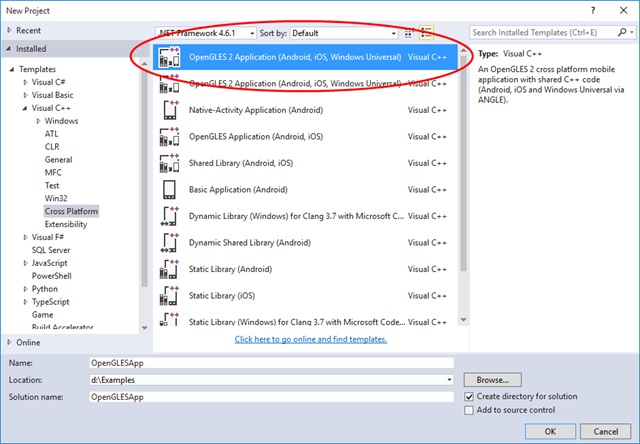
Cross platform (Android, iOS, UWP) OpenGLES 2 application can be easily created in VS2015 using “OpenGLES 2 Application (Android, iOS, Windows Universal)” project template:
Go to Tools->Extensions and Updates, download and install Using Visual Leak Detector:
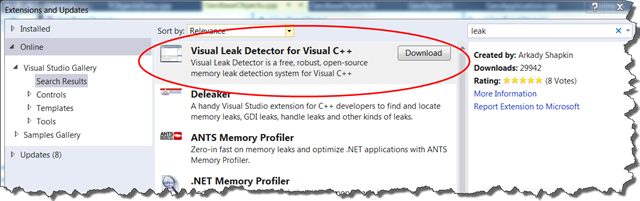
Create a header file, named, for example, CommonTools.h containing the following:
#pragma once

#include "C:\Program Files (x86)\Visual Leak Detector\include\vld.h"

#pragma comment(lib, "C:\\Program Files (x86)\\Visual Leak Detector\\lib\\Win32\\vld.lib")
Include CommonTools.h in at least one file in all the C++ projects in your solution. Build debug version of the program. Visual Leak Detector will write the information on memory leaks to Output window when the program exits.
Today I got “error LNK2005: _DllMain@12 already defined in msvcrtd.lib” while linking some C++ CLI project with MFC support in MS Visual Studio 2013. As described in A LNK2005 error occurs when the CRT library and MFC libraries are linked in the wrong order in Visual C++A LNK2005 error occurs when the CRT library and MFC libraries are linked in the wrong order in Visual C++ article, I added /verbose:lib linker option:

I’ve been working on some MFC application and to apply my WPF knowledge I added a WPF control written in C# to my MFC CView with the following code:
int CMyView::OnCreate(LPCREATESTRUCT lpCreateStruct)
{
    if (CView::OnCreate(lpCreateStruct) == -1)
        return -1;

    try
    {
        gcroot<hwndsource ^> hwnd_source = gcnew HwndSource(0, WS_VISIBLE | WS_CHILD, 0, 0, 0, "HwndSource", IntPtr(m_hWnd));

        MyWpfControl ^ control = gcnew MyWpfControl();

        hwnd_source->RootVisual = control;
    }
    catch (Exception ^ ex)
    {
        String ^ msg = ex->Message;
    }

    return 0;
}
All that I needed to do is to follow the steps described in this post: How do I host WPF content in MFC Applications, fix VS2012 bug described here, and got rid of std::mutex and std::lock_guard replacing them with the following classes using typedefs:
Fortunately, to compile BOOST with MS VC 2010 we need Visual Studio Command Prompt and five commands:
Navigate to BOOST directory, for example:
F:
cd F:\Projects\Lib\boost_1_53_0
A long time ago, STL had auto_ptr<Type> class that automatically deleted a dynamically allocated C++ object when control leaves a block. Personally, I believe that auto_ptr<Type> was typically used in simple scenarios as a local variable or a class member but theoretically it is even possible to declare a vector of auto_ptr<Type> because auto_ptr<Type> stores an ownership indicator and its copy constructor transfers the ownership from the instance being copied, so vector::push_back(…) and vector::resize(…) functions works correctly.